

Introduction: A Busy Morning, a Bottleneck, and a Better Way
It’s a drizzly Tuesday at a Sydney cross-dock, and the arvo rush started early. The pallet stacker at door three is queued, the driver tapping the scanner, and three trolleys are now in the way (no dramas, right?). We drop in an automatic pallet stacker and watch the flow change: pallets clear in a steady cadence, lanes stay open, and the dock boss breathes easier. Here’s the kicker—manual handling still drives a big slice of delays and damage across many sheds, and small stalls add up to hours each week. If the difference is so visible on the floor, what’s actually happening under the hood, and why does it matter to your shift?

There’s a real gap between “it moves pallets” and “it moves your day forward.” Let’s unpack where the old way trips up, then stack it against smarter, self-steering gear.
Traditional Flaws That Hide in Plain Sight
Why do old methods stall?
Here’s the technical bit, kept plain. Look, it’s simpler than you think: legacy walkies and ride-ons rely on human consistency, but the job isn’t consistent. Aisles tighten, labels fade, fatigue sets in, and load center shifts mess with stability. Fixed routes waste time when paths block; fixed buffers waste space when zones are clear. Old controls often sit on isolated PLC logic, so they can’t adapt on the fly to dock congestion or slot changes. When the radio goes noisy, CAN bus chatter drops out and updates lag. That means more inching, more horn taps, more idle seconds. Power converters heat up in summer and derate; batteries sag; torque curves don’t match the push up a ramp at the end of shift. And because there’s no SLAM-grade positioning or LiDAR-based awareness, the machine can’t re-plan around a stray pallet in real time. The result is uneven cycle times and stop–start motion that hurts throughput and confidence. You feel it as “busy but behind,” which is the worst kind of day — funny how that works, right?
Head-to-Head: What Changes When the Stackers Think Ahead
Real-world Impact
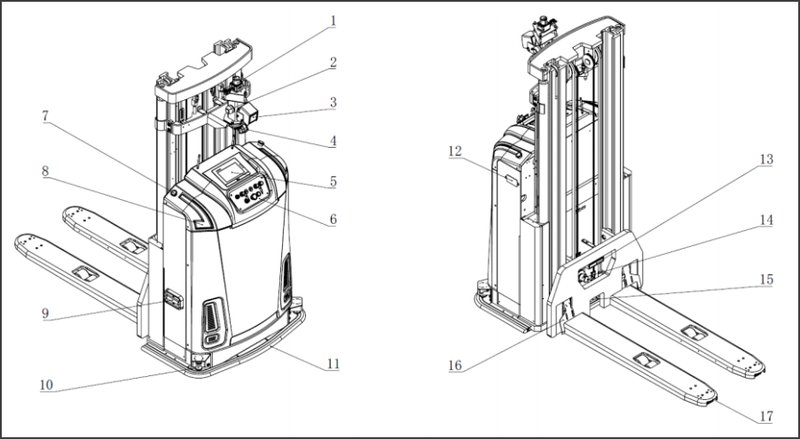
Shift the lens to a semi-formal compare. In a mid-size Brisbane FMCG site, the move from manual staging to an automatic pallet stacker tightened cycle time, but the real win was steady flow. Why? The unit maps the floor with LiDAR and plans with SLAM, then updates routes when a bay clogs—no detour calls on the radio, no waiting for a spotter. Edge computing nodes push decisions closer to the truck, so it doesn’t stall while the server thinks. The WMS feeds live tasks, and the controller prioritises by door dwell and queue length—more brains, fewer bottlenecks. In numbers, teams often see variability drop first, then speed follow. Damage events fall as forks level themselves and verify load center at lift. Less drama. More rhythm.
Forward-looking, the same platform scales well. Add another unit, and the fleet manager balances work without rewiring PLC islands or rewriting route tables—just set zones, caps, and priorities. Updates roll over the air. Maintenance? Predictive checks watch vibration and thermal load on motors and power converters, so service lands before the breakdown. It reads simple because it is: smarter routing, safer lifts, cleaner handoffs. And when peaks hit, the fleet flexes rather than the crew—nobody wants extra overtime because a battery swap ran late (we’ve all been there).
Choosing the right path? Keep three metrics on the dash. First, peak-hour throughput with pallets per hour plus variance—steady beats spiky. Second, safety telemetry: proximity triggers versus actual near-misses, and auto-derate behavior under tight turns. Third, integration latency from WMS task drop to fork engagement—watch the seconds, not just the spec sheet. Measure those, and the better option will show itself without a sales pitch. For a clear view of how these systems come together in practice, you can explore solutions from SEER Robotics.

Leave a Reply